Saturday, April 6, 2013

DOMESTIC WORKERS LABOUR LEGISLATION

A female domestic worker in the time of my grandmother around 1900. You could always recognize domestic workers on their cloths and of course the basket for groceries. I found this photograph in the photo album of my grandmother. Probably she was my grandmother's friend. 

When she was young, my grandmother on father's side served as a domestic worker. It was a humiliating experience but there was no other way to gain some income for her poor family. My mother in law was also a domestic worker when she was young. Her family was also very poor. However, she had good memories of the time she worked as a domestic worker.

For the first time I learned more about domestic workers during our stay in Colombia. First in the flat of father Rosier who was travelling abroad. She was a sweet older woman who did her best to make our lives as nice as possible. Later on we stayed for a few months in a flat of a Colombian friend who was also travelling abroad. The domestic worker was a very young woman. Although we had only one domestic worker in our flat we had the feeling to belong to an old aristocratic English family like you see in the television series 'Dowton Abbey'.

As we grew up in a more or less egalitarian Dutch society with little class differences, me and my wife felt uncomfortable with a domestic worker in our house. We also had the feeling that we had no privacy anymore. It was a strange experience to eat in the sittingroom while the domestic worker was eating in the kitchen. We decided to invite the domestic worker to eat together with us, to share the same table. We then learned that this created an uneasy situation for the domestic worker. That's why we decided not to have anymore domestic workers in our house during our stay in Mexico and Costa Rica. In stead we hired somebody, to clean the house a few times a week.

We learned that wage and labour conditions for domestic workers are on a minimum level like for example a wage lower than the official minimum wage and not one day off or one day off per week. Everything depends from the family she is working for. Is it a nice and understandingly family or are they using the domestic worker as a kind of slave without no or little payment and no free days? In Indonesia I heard about the bad conditions and the abuses of Indonesian domestic workers who had migrated to the oil rich Arab countries with the aim to earn money for their family that stayed in Indonesia.

Brazil

Therefore it was very good news to read that a constitutional amendment guaranteeing equal rights for domestic workers in Brazil has come into force on 2 April. “Manuela Tomei, Director of the ILO’sConditions of Work and Equality Department, welcomed the vote in the Brazilian Senate, which was passed unanimously at the end of March after being approved in the lower house.

With the passing of this law, so culminates Brazil’s process of recognizing the dignity and value of domestic work and domestic workers, who are to a large extent black women - a process which began in 1998 when, for the first time, the Constitution included a number of important labour guarantees for these workers. Today's Senate decision is one additional step towards narrowing the historical divide between the richest and "whiter" stratum of society and the poorest and "darker" lower end of the social ladder,” Tomei said.

It is particularly significant given the dramatic rise in the numbers of domestic workers in Brazil over the last few years – from 5.1 million to 6.6 million between 1995 and 2011. 17 per cent of all jobs for women are in the domestic work sector. Latin America is one of the world’s fastest growing regions in the domestic work sector.”


Global momentum

The IlO believes that because of the approval of ILO Convention 189 and recommendation 201 in 2011 has sparked a global momentum on labour legislation of domestic workers: Argentina also passed a bill in March, which limits working hours and ensures paid annual and maternity leave for domestic workers. The Indian Parliament included domestic workers in legislation to eradicate sexual harassment at work, which was passed last February.

Since the Convention’s adoption, a total of nine countries have passed new laws or regulations improving domestic workers’ labour and social rights, including Venezuela, Bahrain, the Philippines, Thailand, Spain and Singapore. Legislative reforms have also begun in Finland, Namibia, Chile and the United States, among others.

So far four countries have ratified ILO Convention 189 – Uruguay, Philippines, Mauritius and Italy. Several others have initiated the process of ratification, including South Africa, Costa Rica and Germany.

The European Commission is also pressing EU countries to implement the ILO Convention and has called for safeguards to protect young domestic workers.

Facts and figures on domestic workers
WorldwideBy region
  • 52.6 million worldwide
  • 83 per cent are women
  • 29.9 per cent are excluded from national labour legislation
  • 45 per cent have no entitlement to weekly rest periods/paid annual leave
  • More than a third of women domestic workers have no maternity protection
  • Asia and the Pacific: 21.4 million
  • Latin America and the Caribbean: 19.6 million
  • Africa: 5.2 million
  • Developed countries: 3.6 million
  • Middle East: 2.1 million


According to an ILO study from January 2013, entitled Domestic Workers Across the World, at least 52 million people around the world – mainly women – are employed as domestic workers. At the time of the research, only ten per cent were covered by general labour legislation to the same extent as other workers. More than one quarter were completely excluded from national labour legislation.

ILO legal specialist on working conditions, Martin Oelz, said that the signs are encouraging: “The Convention and Recommendation on domestic workers have effectively started to play their role as catalysts for change. Giving social dialogue a central place, these global minimum standards now serve as a starting point for devising new polices in a growing number of countries.”

The above italicized text, the map and the worldwide facts are coming from the ILO website.

Friday, March 29, 2013

CHILD LABOUR SCHOOL

Some of the children who are attending the newly created Child Labour School of the Bangladesh trade union BSCWF

The core bussiness of trade unions normally is to establish a collective agreement by negotiating about wages and working conditions with the employer or in case the union is dealing with a whole sector, like for example building and construction workers or textile workers, then the trade union has to negotiate with a group of employers. But what to do in countries where a huge amount of people don't have work or only informal work like streetselling or doing small jobs for a few hours? What should a trade union do when children are working because the parents do not earn enough income to live? And to make things worse, what to do when these people don't have any social protection or health care service?

The children attending the Child Labour School get also to eat during school time.
These are questions many trade union leaders around the world have to answer. For example it is obvious that child labour should not exist. In stead of working, sometimes under harsh and dangerous conditions, children should go to school and have time to play around. That is why the International Labour Organization ILO for already a long time is focussing on child labour by adopting special conventions andrecommendations on child labour with the aim to get rid of child labour worldwide.

They are right, children are entitled to education.
But conventions, recommendations and even laws are not enough to eradicate child labour. What is also needed are practical measures and initiatives to help families to get a better income and to help children to get a better future. That is not easy, especially not for trade unions which have no or just limited possibilities to do something. But that there is always a way to do something, even in a poor country like Bangladesh, is demonstrated by the Bangladesh Trade Union BSCWF. During their board meeting in November 2012 the BSCWF decided to start to organize a so called Child Labour School.

Meeting of the parents of the children together with one of the teachers and Warish Ahmed,secretary general of the BSCWF
To give the children a better future, the BSCWF together with the parents decided to start a Child Labour School. The Child Labour School is meant for children of dues paying members and activists of the BSCWF who are working with their parents on their working place. Because of lack of means, it will be a difficult task. But taking the responsibility to do something is the first big step on the long road to create a better world for the children. Therefore we wish the parents, their children and of course the BSCWF lots of succes with their Child Labour School.

Friday, March 22, 2013

THE CRISIS? MERKEL'S FAULT OF COURSE!

Effligies of Angela Merkel and Nikos Anastadiasis on display at a carnival in Limasssol, Cyprus

The following article comes from the website EUROPRESS. On this site you can read the article in its original Spanish text as well as many other languages.

******

The aid plan launched by the Eurogroup in return for a tax levied on Cyprian bank deposits has provoked violent reactions. Germany is often accused of wanting to punish a struggling country. However, it’s not the Chancellor who is to blame for the mistakes of the island, writes an economist.

By John Müller

In this latest crisis hitting the euro, it’s not the Cypriots who are at fault; it’s Angela Merkel and her government – don’t waste time looking for other explanations. It’s not the fault of a bloated banking sector that holds €128bn in assets in a country with a GDP of €17bn – it’s Merkel who did it.

Don’t blame those banks that, as the German secret service warned in November, opened their vaults to €21bn from Russian Oligarchs without looking too closely and accepted – no questions asked – a few other thick wads from Arab millionaires (from fortunes that are hard to justify). The banks practice International Personal Banking and "tax optimisation"; Merkel, in contrast, labours under a Protestant sense of morality.
It’s not even the fault of the money managers who put 50 per cent of their money – that’s right, 50 per cent – into Greek bonds, purely out of patriotism (Cyprus is half Greek), even though they knew that they risked losing it all. No, that’s Merkel’s fault.

Christofias's crisis

It’s certainly not the fault of Sigmar Gabriel, the agreeable German Social Democrat leader, who cut off all lines of retreat for the Chancellor: "I cannot imagine the German taxpayer bailing out Cypriot banks whose business model is based on allowing tax evasion." The entire blame, of course, falls on Merkel.

Nor is it the fault of the pathetic ex-President of Cyprus, the communist Dimitris Christofias, an autocrat formed in the Soviet Komsomol (perhaps the reason why there are so many Russian bank accounts in Cyprus), who was not in the habit of consulting his ministers, the parliament or the central bank.

The Guardian, a newspaper that cannot be suspected of ill will, accused him in December of leading the country into "a sorry state." Christofias was the one who decided in 2011 to keep in Limassol harbour the ship carrying explosives to Hezbollah, which then blew up and took out the only power plant in the country. He also supported the president of one of the two big banks, the Marfin Laiki, when it decided to shift its headquarters to Greece despite opposition from the central bank of Cyprus. His last act of foolishness was refusing to allow negotiations on the merger of the Marfin Egnatia Bank of Greece with the Laiki Bank of Cyprus when the famous offshoring to Greece was decided on, a move that cost Cyprus €4bn in assumed liabilities. With that, this economic genius sank his country. But no – it’s all Merkel’s fault.

Weak leader

Nor does it appear that his brand-new successor, Nicos Anastasiadis, a weak leader playing the game of ‘blame Europe for what I have to do,’ should shoulder any responsibility at all. Anastasiadis props himself up on half-truths to plunder the deposits of the Cypriots instead of starting with sending a bill to the shareholders and creditors of the banks. But of course, that would end the cushy financial system that they have built up and that they expect to continue to live off. Schäuble reminded him yesterday that the idea of robbing depositors didn’t come from Germany. But no. It’s all Merkel’s fault.

And it’s Merkel fault, too, for allowing Anastadiadis to toy with the prestige of the Eurozone, as Papandreou did before him. And because four years ago she didn’t stand firm and veto Cyprus’s entry into the eurozone. Because she let herself be fooled by the certification of the OECD that Cyprus had met 40 EU directives against money-laundering. And, in passing, it’s also the fault of Christine Lagarde, of the IMF, which supported it. Do you recall who it was who handed the Greek minister the list of tax evaders, the one that got lost? As if Lagarde knew nothing about the state of the Cypriot banking sector! But no. It’s all Merkel’s fault. And it had better be her fault, because any other theory will leave us standing naked before our own cluelessness.

Translated from the Spanish by Anton Baer

Friday, March 15, 2013

EUROPEAN PROTEST

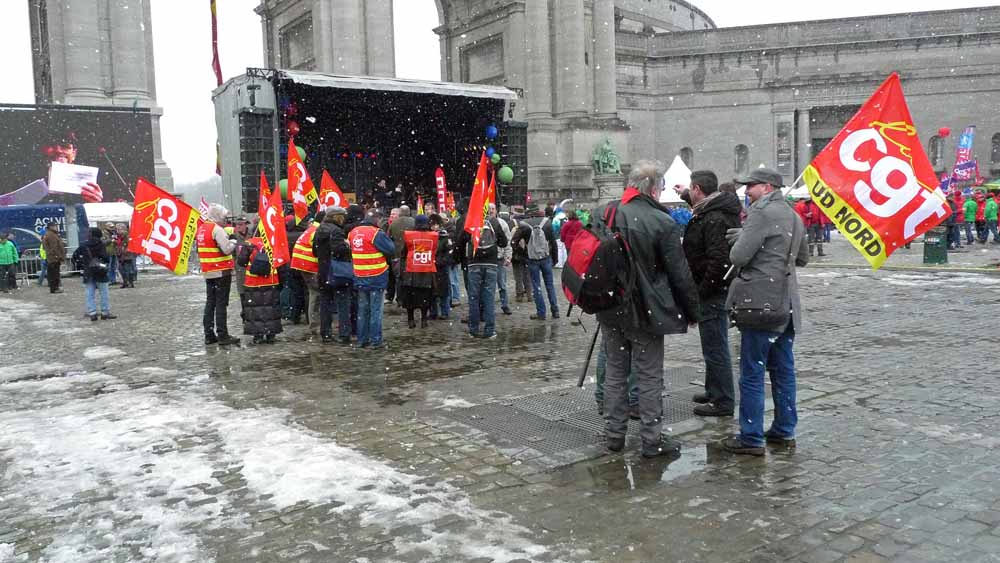
Every beginning is difficult, even that of a manifestation. It's cold (about 3 degrees) and it begins to snow.

Below some pictures of the European protest manifestation that the ETUC has held on Thursday 14 March in Brussels during the two-day summit of European leaders in the same city. The ETUC calls for less austerity and more growth through investment. For European leaders a dilemma. Excessive deficits in national budgets provoked reactions from distrustful international capital, which ultimately may threaten the existence of the Euro and consequently destabilize the whole European economy . But rising unemployment due to the economic crisis leads also to ever greater social tensions that ultimately could threaten the democratic stability of Europe. What to do? It seems that Europe stands with its back against the wall.

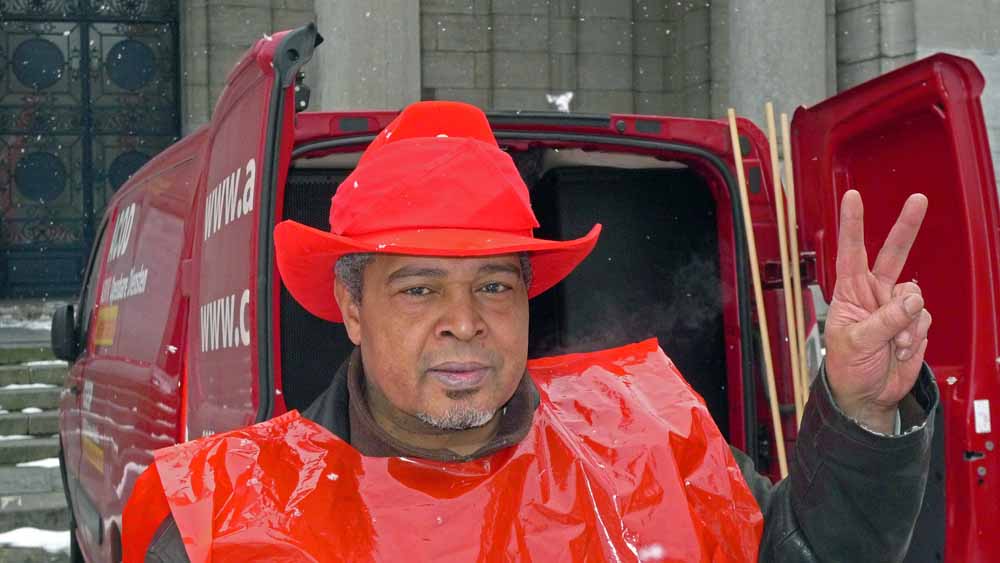
This red cowboy hood men believes in victory for the union


The unions do not give up and continue to advocate for a more social Europe. It looks more and more European leaders in particular Herman Van Rompuy, President of the core European Council of Heads of Government, and José Manuel Barroso, President of the European Commission, realize that time is running out. During the summit, they called the Government urgently to work on the arrangements made to reduce unemployment, especially those among the young.


The first men with flags are coming on the square. These are from the Belgian socialist federation ABVV / FGTB, flemish part.


Snow is falling while there is still a lot of snow on the ground. 
However serious, a modern trade union manifestation has also something of a little festival hence the pop musicians on stage. They do forget the cold and the snow.

The Belgian trade union movement is colorful because every organization has its own color: socialists in red, Christians in green and liberals in blue

As a good host, the Belgian trade unions ensures free french fries, soft drinks and beer.
The Greeks may suffer most from the economic crisis, they present a small folklore festival, even when it is snowing heavy.
Some use the opportunity to give their protest a carnivalesque face

Their carnavalesque painted faces makes them look even more serious.

The Czech delegation comes from far but is no less cheerful.

The workers of the Belgian Ford factory in Ghent and Arcelor metal in Liège on stage require extra attention for their cause. Their factories are closed together with the suppliers.

It's the capital that is expensive not the unemployed, says the sign of this serious looking woman.

The union band cheers the crowd. Like magic it stops snowing.
Young unemployed from Grand Duchy Luxembourg show clearly on a symbolic way that they have no future without employment
These Polish nurses look worried about their future.
It is a doubtful gesture of victory but it is still there.
For a Better Europe. The Red Anger!!!

Some official speakers are boring but it looks if this one gets light and support from Heaven.

Are we witnessing the beginning of the revolution?
Things are becoming hot like this protest fire of the metal workers of Arcelor Liège
Some take precautions and immediately cover their face with a scarf against the black smoke.
Red meets Blue.

Sunday, March 10, 2013

ETUC: ROADMAP FOR A EUROPEAN SOCIAL DIMENSION


Through a series of emergency measures the European Eurozone has managed to recover international confidence in the Euro. The Euro has come into calmer waters. The value of the euro against the dollar is back to its old level. The European Central Bank monitors the 200 largest European banks. The ECB has also agreed, to act as soon as possible a country has to pay too high interest rates on their loans. There are special emergency funds to help forward those countries that are no longer able to borrow on the international market at a reasonable rate. A special European Commissioner maintains strict surveillance of national budgets, so that they do not exceed the 3% norm. In the event that this happens, a country receives automatically a high penalty.

So with the Euro it is going better now, but not with the European economy. The economic crisis is getting deeper and not just in countries like Ireland, Greece and Portugal the first to be hit by the debt crisis, but also in countries such as Spain, Italy, France, the Netherlands and Belgium. The only country that has so far managed to escape from the economic crisis is Germany. Some people go so far as to think that Germany is benefitting from the economic misery of the other European countries. Others believe that Germany, in contrast to those other European countries, has become a global competetor.

European leaders realize of course that the economic crisis has not only political consequences, such as the growing political distrust towards 'Brussels' ('Brussels' is no longer the solution but the disease), but also may lead to more social tensions. Hence, the European leaders last December decided that the roadmap for the completion of the European Monetary Union (EMU) should include a social dimension, comprising social dialogue. President of the European Council Herman Van Rompuy called for proposals on the social dimension of the Economic and Monetary Union. To assemble the views or institutional stakeholders, social partners and civil society organisaties, Europe is holding a hearing on "For a social dimension of the European Economic and Monetary Union".

In response to this invitation the Executive Committee of the European Trade Union Confederation ETUC made the following declaration: “The ETUC considers that the proposal to discuss a social dimension of the EMU is too restrictive. Our commitment to the process of European integration depends on the fact that Europe is not a free trade zone, but an area whose objectives are economic and social progress. Therefore a discussion on the social dimension of the EMU is only acceptable if it triggers social progress in the whole of the European Union.
ETUC opposes current austerity policies. They are implemented to the detriment of working people and citizens who have been made the variable of adjustment. This is not acceptable. These policies are also counterproductive and are having a negative impact on the EU’s economy. The financial sector has been saved, at an unsustainable cost. There can be no social dimension whether in the EU or in the EMU without a change in these policies. The ETUC will continue to mobilise towards that end.
ETUC considers that a roadmap on the social dimension of the EMU, in the framework of increased policy coordinations should aim at upward convergence to deal with inequalities, poverty, unemployment and precarious work that are ethically unacceptable and are creating a social emergency. There can be no sustainable economic governance and coordination of policies if these injustices are not addressed.
ETUC demands new large scale investment plans equal to at least 1 % of EU GDP annually to promote sustainable growth and jobs. The current Multiannual Financial Framework (MFF) proposals are a retrograde step and totally inadequate to meet our objectives.
The ETUC strongly underlines that social partners must be included and fully involved on an equal footing in the debate about the design of new coordination instruments. There should be effective guarantees at all stages that trade union rights and fundamental rights will be respected and promoted, particularly the autonomy of collective bargaining.
Contractual arrangements in the form of memoranda have been put in place undemocratically and have imposed the wrong policy mix. They infringe collective agreements, industrial relations and social dialogue. This should not apply to any contractual arrangement. Financial support has been made conditional for such contractual arrangements. The ETUC opposes this unfair and undemocratic approach.
On the basis of the Social Compact it has already proposed, the ETUC will further develop its position and press its policies in the context of the debate on the social dimension of the EU and EMU.”

In this declarartion you can read the dilemma the European labor movement currently is facing. The ETUC calls for more European coordination by a stronger 'Brussels' while the political unease in the EU member states about the growing power of Brussels increases. The ETUC enters with this declaration in a strong political debate that touches also many national and nationalistic sentiments like for example the delicate question of the so called cheap labor migrants coming from Eastern European member states. It will not be easy for the ETUC to handle politically this debate within and outside its ranks.

Sunday, March 3, 2013

TRADE UNION CORRUPTION IN MEXICO


Corruption is everywhere. It is a disease that can affect everyone and every organization worldwide including trade unions. Poor and working people suffer most from widespread corruption. That makes corruption within the trade union movement particularly tragic.

Tuesday 26th of February Elba Esther Gordillo, head of the Mexican teachers' union SNTE (Sindicato Nacional de Trabajadores de la Educacion) , was arrested because she would have embezzled about 120 million Euros of the trade union. This was announced by the Mexican Ministry of Justice. She is considered as one of the most powerfull persons in the country. She could convince the 1,5 million members of the SNTE to vote as one block in favor or against a politician.

The 68 year old trade union leader, also known as 'La Maestra' (the teacher), has been active in politics since the eighties and had a lot of influence in the administration. But earlier in the week, the educational system in Mexico has been reformed, allowing abuses such as buying a job as teacher should disappear. The Ministry of Finance conducted an investigation into transactions with trade union funds and found that more than 2 billion pesos (about 120 million €) had been transferred to personal accounts of Gordillo. She was arrested at the airport of Toluca. Three other persons, that would have stolen money from the trade union, were also arrested .

Former employee Professor Noe Rivera declared that Gordillo is a person without morals and has turned the trade union into an election machine. That gave her a lot of power. “It's an unscrupulous woman, who spies those whom she wants to buy, to join or to destroy," said Rivera. He told that the Citizen Association of Teachers since 2006 investigated the diversion of funds and found that in 18 years Gordillo handled more than 104 billion pesos. The greatest gift made by Elba Esther was a house in Zihuatanejo "to a well-known journalist."

Unfortunately this is not the first time that Mexican union leaders are accused of corruption. In the seventies, a group of trade unionists of the PEMEX union, camped on the Zocalo in Mexico City protesting against corruption in their union. They told that the union leadership sold jobs for such high prices, that workers had to ask for a loan from the union. The result was that many workers for the rest of their lives had to pay to their own union. You could call this a modern form of slavery. The corruption had penetrated also deep into the company involving many employees. It was generally believed that this was the main reason PEMEX was not profitable enough as otherwise would have been.

This is a very sad situation especially because trade unionism is one of the main instruments of workers to promote more fair wages and working conditions as well as a more equal distribution of wealth based on transparancy. Corrupt trade unions act therefore always against the interests of the workers and especially the poor. Therefore trade unions should declare corruption on whatever level as their first enemy. International trade unions and the ILO must fight against trade union corruption without hesitation and with all means they have at their disposal.

Friday, February 22, 2013

MINIMUM WAGE IS BACK ON THE INTERNATIONAL AGENDA

German strikers in may 2012.(Photo taken from the German Christian Metal Trade Union CGM )


America and Germany want to raise the minimum wage to fight poverty. Opponents fear that a higher minimum wage will destroy jobs.

Germany is the major economic example in the European Union. Southern European states, but also northern countries such as the Netherlands, look enviously to the German economic growth. Unlike the Netherlands and many other European countries, Germany has no minimum wage. That has to change, before the elections in September, says the German Christian Democratic Party (CDU/CSU).

The Christian Democratic Party sees the minimum wage as the best way to fight poverty. Currently, 6 to 8 million Germans are working for less than 8 euros per hour. Despite their full-time jobs, they have to turn to municipalities for additional assistance because they are living below the subsistence level. The Social Democratic Party SPD calls this unhuman.

The liberal coalition partner of the CDU, the Freedom Party FDP, strongly opposes the minimum wage. This party emphasizes the economic importance of the absence of the minimum wage. If labor is expensive, jobs will be lost, they argue. Germany now has some kind of a minimum wage by sector, but in sectors with many international competition the minimum wage does not exist.

The German Economic Growth also has its dark side. Because of the he lack of a minimum wage millions of Germans need assistance from local authorities or are threatened by poverty.

Partly this is the formula behind the German economic success. But the economic growth rates has a shadow side: increasing poverty. The number of Germans living near the poverty line, is around 16 percent. In the United States, the federal minimum wage is $ 7.25 per hour. States may have their own minimum wage, but the majority of the states follows the wage directive of Washington. Like the German Christian and Social Democrats, Obama sees the minimum wage as a way to fight poverty in his country. He wants to raise the minimum wage of $ 7.25 up to $ 9 per hour, he said last week.

President Obama wants to raise the minimum wage in the United States.

Various economists, employers and Republicans don' t believe this is a good idea. They use the same argument as the Liberal Party FDP in Germany. Increase the price of employment and you get less of it, said the Republican chairman of the House of Representatives John Boehner. These critics point out the implications of the last increase in 2009, when 600.000 jobs for low-paid teenagers would have been lost. Employment figures show that approximately half of the 3.8 million employees with a minimum wage is younger than 25. With a higher minimum wage, these jobs are at risk, these critics argue.

The $ 9 an hour minimum wage Obama proposes is nothing compared to the $ 21 per hour minimum wage that the American Center for Economic and Policy Research last week calculated, based on the increased labor productivity since the fifties in the past century.

This is the translation of an article published in the Dutch newspaper Trouw of 18 February 2013