Wednesday, January 14, 2015

THE PROPHETS OF THE CONSUMER SOCIETY

"Dance to the Euro", a digital adaptation of "Dance to the Golden Calf," etching by Pieter van der Borcht (1582/1585), Museum Boijmans van Beuningen, Netherlands. Made by Petrus Nelissen.

As a normal person, you believe inflation is not so good. Because of inflation you have to work more hours to earn the same as before the inflation period. For example, firts you had to work one hour for a sausage, with continued inflation you need over time to work two hours work for the same sausage. As a result of inflation your work is getting cheaper. So you should avoid as much as possible inflation. 


The funny thing is that many economists think about it very differently. They believe that inflation is a good thing. For example the European Central Bank's task is to keep inflation around 2%. That means that after five years of inflation, 100 Euros will actually be worth only 90 Euros. After thirty years, those 100 Euro have only worth about half.


As long as salaries increase annually by 2% and the tax bill remains the same, nothing goes wrong. You will continue to work just the same amount of time for the same amount of money. You will not become richer nor poorer. This also applies to pensions and other social benefits. As long as these are increased by 2% annually, there is nothing wrong. If this is not the case, those who receive social benefits are getting poorer. Social benefits are determined by politics, therefore a raise of social benefits will always be a matter of government and consequently part of a political struggle. Payment of social benefits politicizes the society, either left or right.


If the political decision is taken that the social benefits will no longer be adjusted for inflation, those who receive social benefits will impoverish. Because of the economic crisis, through which the state has less revenues,  the political pressure will grow to adjust not anymore the social benefits and public sector wages to the inflation rates. The costs of the economic crisis then are transferred to those who receive social benefits and to all those other workers whose wages will no longer be adjusted to inflation.

Macron also called on the European Central Bank (ECB) to quickly come up with measures to push inflation towards the target level of just under 2 percent. "This is the time to give in gas, "he said. The next meeting of the ECB's monetary policy on 22 January. (The French Minister of Economic Affairs in the Times Online yesterday evening)


But why economists still believe - limited - inflation is a positive economic phenomenon? The reason is that  in the long run, inflation erodes Government debts. Inflation gives Governments lower valued money which makes it easier to pay off the debts. It looks like debts are in the long run converting into smoke. A 100 Euro debt after 5 years  of a 2% inflation will be be only 90 euros worth.


In times of inflation nobody wants to lend money anymore, therefore the interest rate will be increased. A good example was the recent collapse of the Russian ruble. Each day the ruble lost value against the dollar. That meant a rise in the prices of import goods (more rubles for the same amount of goods) while inland also prices are going to rise. To attract foreign money and new investments the Russian Central Bank raised interest rates to 17%. That helped a little bit but not enough to restore economic growth.
In such a case the economy collapses due to the excessively high interest rates. So high that a Government can not borrow money anymore. This for example was the case with Greece and some other European countries a few years ago. Inflated money destroys the economy because investors lose confidence and try to get their money out of the country. Also citizens lose confidence in their national currency and try to export their savings or to change it in another currency. This of course leads to impoverishment of the country and its citizens.


Despite the economic crisis, and the perils of the debt countries Greece, Ireland, Spain and Portugal, Europe has averted such a downward spiral of inflation. But on the other hand, Europe has a lot of difficulties to get out of its economic crisis. It continues struggling with the economic growth and the high unemployment. To stimulate the economy, many economists preach right up to the European Central Bank, to promote inflation by throwing cheap money into the market. Their reasoning is that with cheap money, people will again consume more and companies will start to invest. Inflation is the lubricant that will get back to work the economy. If the engine is running once again investments will follow faster and  the unemployment rate will drop.


At the end, inflation economists are thus eminently the prophets of the consumer society and they are not alone. There are more prophets of the consumer society such as politicians, trade unions and employers. With the help of inflation politicians hope to avoid to make tough policy choices and economic reforms. With inflation going on they can continue to hand out money. In their words "money for new policies"  which is more of the same so they will again draw voters. The unions believe that reforms can be avoided despite the graying population, technological innovations that changes the whole industrial complex, and globalization that continues to increase. Employers believe inflation will help them to stay on the market without to much reforms in their enterprise. 


Sunday, January 4, 2015

THE DOWNFALL OF THE WCL 44 ( about Leo Tindemans)

From left to right: Leo Tindemans (Minister President of Belgium and President of the Christian Democratic People's Part EPP), Heiner Geissler (Secretary general of the German Christian democratic Party CDU) and Helmut Kohl (President of the CDU) during the first Congress of the EPP in Brussels in 1978.

Leo Tindemans recently deceased on December 26 at the age of 92. He has been twice Belgian prime minister (1974-1978). In the European elections of 1979 he received the highest number of preferential votes ever reached in the history of Belgium. From 1976 to 1986 he was chairman of the Christian Democratic European People's Party EPP. For ten years he was also a member of the European Parliament (1989 -1999).

What the Belgian and European Christian democratic politician Leo Tindemans has to do with the history of the WCL? Nothing really, but that's precisely the problem. Before the WCL Congress in Mauritius (1993), I contacted Tindemans - as requested by WCL General Secretary Carlos Custer- to ask him if he wanted to held a speech on the WCL seminar prior to the WCL Congress about the role and significance of the European Union for European workers and for the World in general. Also, the question was whether he wanted to support the WCL in obtaining European funds for the seminar in order to reduce the cost of the Congress.

State Funeral of the Belgian Politician Leo Tindemans on January 3, 2015 in Edegem, a village not far from the city of Antwerp.

I was surprised how easy it was to make an appointment with Tindemans. We had a pleasant conversation which showed that he wanted to cooperate with the WCL. I was glad with this result. This could be the start of the kind of work that by many people of the WCL was expected I would do after I was appointed as Confederal Secretary of WCL, namely to organize political and financial support for the WCL on European level. But when ACV / CSC chairman Willy Peirens, also WCL president, heard about these plans, to my surprise, he wanted to know nothing of further contacts with Tindemans. According to his staff (Peirens himself never talked with me about this) because in the past the ACV/CSC had several conflicts with him.

I believe this was an irrelevant argument because I did not speak Tindemans as a Belgian politician but as a very important European politician of a country that at that time also had the presidency of the European Union. Moreover, since when unions do not want to meet politicians with whom they have conflicts? Such an attitude destroys all possibilities of a social dialogue.

Apparently my arguments did not convince him. The ACV/CSC wanted no more contacts with Belgian politicians who played a role on European level. When later on also cooperation between WCL and EZA (Europäisch Zentrum Arbeitnehmer - European Center for Workers), which offers European subsidies for European seminars for workers, was blocked by the WCL President, it became clear to me that the WCL was cut off from every kind of political and financial support of the European Union. About why I had no idea. In the case of EZA this was very special and certainly remarkable because at that time CNV former General Secretary Arie Hordijk, a staunch ally of the WCL, was elected chairman of the EZA. Moreover, the ACW (the general Christian workers association of which ACV / CSC is the main organization) was a member of EZA and as such represented in the Executive Committee of EZA.

Why then this blockade? Had it something to do with my position at the WCL? Indeed, the ACV/ CSC had voted against my appointment to WCL Confederal Secretary on the WCL Executive Committee meeting in Gdansk, Poland (1991). Or was it possible that the ACV had made (secret) agreements about EZA and Europe with the European Trade Union Confederation (ETUC)? It was well known that the ETUC opposed strongly the EZA, because in their view EZA received European subsidies that belonged to the ETUC. Or was it a political conflict because EZA was founded by Christian Democrats and as such was supported by the European Christian Democratic Party (EPP of which Leo Tindemans was an important member) while the ETUC majority was socialist oriented?Or was it possible that the ACV / CSC was blackmailed by ETUC that once the WCL would dare to interfere in European politics, Willy Peirens would lose his position as one of the directors of the ETUC?


Even more remarkable is that with the arrival of Willy Thys as Secretary General of the WCL, suddenly collaboration with the EZA was possible. Why this radical change in policy? That question was never answered. Maybe that once will be written also this chapter of the WCL history.

Saturday, December 27, 2014

THE DOWNFALL OF THE WCL 43

Eduardo Garcia Moure (centre) and Julio Robert Gomez (left on the photo) were two of the protagonists of the merger of CLAT with ORIT into the CSA. 

In May 2000 it was announced that CLAT General Secretary Emilio Maspero was deceased as a result of cancer (see my previous blog). Unfortunately, the outside world was never informed. I have no idea why this has not happened. Perhaps dying by cancer is still a taboo in Latin America. Maybe Maspero himself and the CLAT Board Members, which I assume they were aware, were afraid of political consequences and conflicts over his succession.

Maspero was succeeded as General Secretary of CLAT by the Cuban exile Eduardo Garcia, for decades a member of the Executive Committee of CLAT. It was no secret that Enrique Marius, Deputy General Secretary of CLAT for international relations, was disappointed at this turn of events. He would have loved to be the successor to Maspero. But Eduardo Garcia was much better known and more popular in Latin America than Marius. As director of ILACDE, the Institute of CLAT for international cooperation, his position was not easy. Incidentally he had to criticize member organizations of CLAT because of shortcomings in the presentation and implementation of projects.

Enrique Marius, Eduardo Garcia and Rodolfo Romero (Paraguay) were the only ones of the newly elected board CLAT who lived and worked in Caracas. The other Deputy General Secretaries of CLAT - Felicito Avila (Honduras), Julio Roberto Gomez (Colombia), Mario Morant (Argentina) and Anselmo Pontilius (Aruba) - continued to work and live in their own country. The new CLAT Board continued the policy of Maspero. Unfortunately was lost on this occasion the opportunity to make some innovations in the Board and the CLAT policy. It would have been good for CLAT, if a woman had become member of the board, as well as a representative of the trade union action. It might have led to a shift of less (party) politics unto more practical trade union work.

This photograph gives a rare view of Secretary General Willy Thys with his whole WCL secretariat with in the center the ILO Director General Somavia and WCL President Fernand Kikongi. On the left of the center: Eduardo Estevez (Argentina), Fred Pools  (Belgium) and Toolsiray Benedin (Mauritius).On the right: Necie Lucero (Philippines) and Piet Nelissen (Netherlands)

In the autumn of 2000, the WCL Confederal Board met in Washington. WCL had managed to invite two keynote speakers for this meeting: the Managing Director of the IMF, Michel Camdessus (France) and ILO Director General Juan Somavia (Chile). It proved that the WCL as a minority organization, was able to conduct a social dialogue at the highest level about social and economic policies for the benefit of workers worldwide.

Especially the Belgium trade union confederation ACV/CSC did important work in this area because of their good relations with the governor of the Belgian National Bank and the presidency of the Human Rights Workers Group at the ILO. With financial support from the Belgian government several international meetings were held in Wahington during which WCL leaders from different continents had meetings with IMF experts and World Bank staff. At these meetings, the trade unions could express their criticisms and demands on the role of the World Bank and IMF in the international debt crisis, its reform policy and its consequences for developing countries.

For this Confederal Board I had planned to raise the question about the organization of the secretariat, by not presenting the usual report on European activities. Of course, it is not customary to do so but there was no other way left. The secretary General did not want to take measures to strengthen the European secretariat. It was a personal form of protest against the state of affairs at the secretariat. Due to lack of resources and vision, all the work in de past in Central and Eastern Europe threatened to have been for nothing. That in itself was reason enough to pull the bell but there was more. By neglecting the European base of the WCL, the survival of the WCL became itself at risk.

IMF Managing Director Michel Camdessus speaking at the WCL Conferral Board meeting in Washington (2000)

My protest was not successful. That the continents stayed silent, I could understand from their point of view that Europe is for the Europeans. On the other hand, I expected that high level WCL leaders would have the insight that a weak European base eventually had to have an impact on the survival of the WCL. The European unions were, after all, by far the largest financiers of the WCL, on the first place the Belgian trade union confederation ACV/CSC followed by the Dutch trade union confederation CNV.

That the ACV/CSC trade union confederation did not react and thus supported their General Secretary was logical and understandable. But that no European organization reacted, not even “my own CNV”, I found very disappointing. I had hoped that my action would have resulted in at least a debate, a debate that had come to a dead end at the secretariat. Also I did not succeed to develop a common WCL policy vision on European affairs, while on the European agenda there were new ambitious European projects like the introduction of a common currency, that is to say the Euro, that in one or another way would affect all European Union workers. Apparently such policy was the exclusive domain of the ETUC (and I believe, in consultation with the ICFTU).

My position was already not easy. It had started earlier with an overt accusation of the General Secretary on a European coordination meeting that I had organized without budgetary coverage, projects and missions in Central and Eastern Europe. I was shocked that this was not discussed beforehand because then he would have been aware of the falsity of his claim. However, during this meeting ACV / CSC policy officer Paul Buekenhout openly recognized that spendings were indeed justified in view of the financial commitments of the ACV / CSC trade union confederation itself. Later, the Secretary General attempted to dismiss me. Thanks to the CNV trade union confederation those actions had no results. Obviously the situation between General Secretary Willy Thys and myself had become increasingly difficult.

Saturday, December 20, 2014

WOW (World Organization of Workers) Annual Review 2014

Dear Friends,

I hope you enjoy the Annual review of WOW activities in 2014 published on You Tube: Board Meetings, European seminars, the ILO Conference WOW participation, WOW mission to West Africa and CLAC-WOW meeting in Santiago the Chile.


I wish you a Merry Christmas and a Happy New Year - Feliz Navidad y Feliz Ano Nuevo -Joyeux Noël et Bonne Année - Frohe Weihnachten und glückliches Neues Jahr - Feliz Natal e um Feliz Ano Novo - Perttige Kerstdagen en een Gelukkig Nieuwjaar.

Piet Nelissen


Monday, December 15, 2014

FIFTH LATIN AMERICAN-CARIBBEAN COORDINATION MEETING CLAC WOW


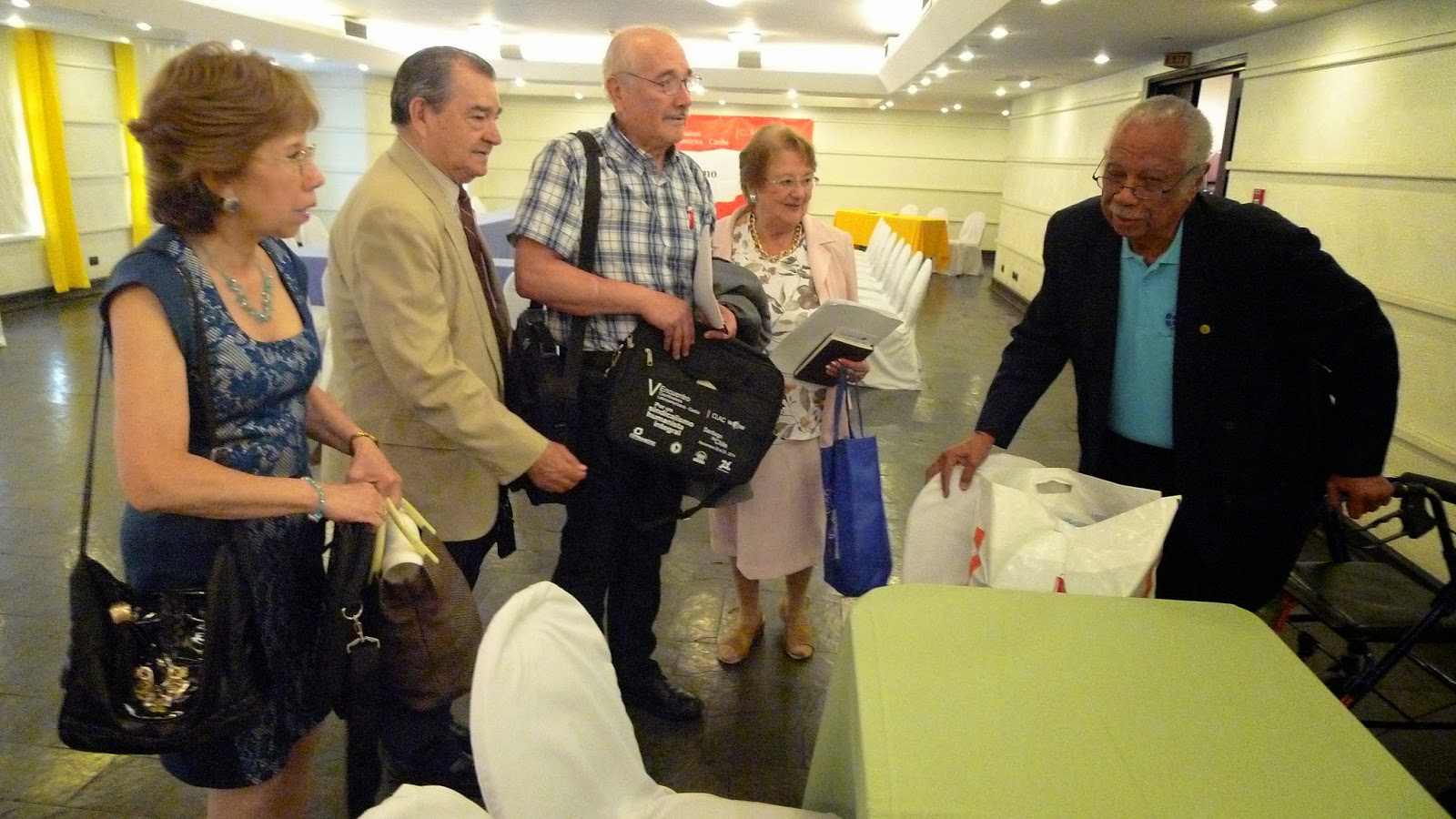
The Fifth Annual Latin American Coordination meeting "For an Integrated Humanistic Trade Unionism" took place in Santiago, the capital of Chile, between November 23 - 25. The meeting was organized bij FELATRACCS (The Latin American Federation of Workers in the Communications and Cultural Sectors) together with the Chilean Federation of Workers in the Communication Sectors (FETRACOSE). Some 40 trade union delegates from 14 different countries participated in the meetings and working sessions. Together they represented the three federations FELATRACCS, FELATRABS and FETRALCOS affiliated to the WOW. A special guest was President Oscar Semerel from Curacao of the Latin American Federation of Pensioners CLATJUPAM together with the Chilean Union of Pensioners UNAP A.G. 
The first day was dedicated to remember what happened in Chile during the dictatorship of general Pinochet (1973 - 1990) with a visit to the Museo de la Memoria and to the Circle of Journalists House in Santiago. After these visits on the Sunday morning, every Federation held its own boardmeeting in one of the halls of the hotel.


While waiting for the bus for a visit to the Museum de la Memoria, the first group picture was spontaneously taken in front of the hotel.


The Chilean Museum de la Memoria was founded with the intention that one should not forget
what happend during the Pinochet dictatorship. During the visit everybody received a red rose
that could be placed there where your thoughts go.


After the impressive visit to the Museum de la Memoria we went back to the centre of the city
where we walked along the Moneda Palace and the monument of President Allende
to the Circle of Journalists House.In the meanwhile our Chilean friends told us about the history of the palace and the putch of general Pinochet against the Government of President Allende (1973)

The Government of the democratic elected President Allende of the Unidad Popular Coalition
 was overthrown by the Chilean army led by General Pinochet in 1973. After te fall of the dictator in 1990 the democratically elected Government decided to erect a monument to honor him.

In the House of the Journalists were commemorated all those journalists and other media workers
who were killed or disappeared because of their profession with red roses placed on a special monument in the House that is dedicated to them. 

Preparing the boardmeeting of FELATRABS

Preparing the meeting of CLATJUPAM President Oscar Semerel with the boardmembers of the Chilean pensioners union UNAP A.G.


Monday was largely reserved for a conference in collaboration with the Universidad de Chile. The main theme was "communication, globalization and democracy. "As you can see on the displayed program, two panels were held. The first panel was devoted to "An integrated Latin American trade union movement" followed by a panel on "Perspectives in the exercise of social communication in Chile." The debates and discussions were interrupted by a musical performance by Manuel Sanchez, singer, folk poet, troubadour and guitarist.

After the colloquium the Fifth Coordination Meeting CLAC - WOW was officially opened in one of the meeting rooms in the hotel. Words of welcome were spoken by Abraham Armijo, President of FETRACOSE, José Jesus Trabulho, President of FELATRABS, Maritza Chireno, President of FETRALCOS, Roberto Mejia, President of FELATRACCS, Francisco Iturriaga, President of UNAP A.G., Miguel Duche, Vice President of WOW, The Local ILO representative, Piet Nelissen of the WOW World Board. The Coordination Meeting was officially inaugurated by Minister of labour Francisco Javier Diaz.


Here we see the second panel on "Perspectives in the exercise of social communication in Chile"
with Javiera Olivares, president of the Association of Journalists (left), Laureano Checa,
Director of the School for Journalists of the University of Chile (middle)
and Abraham Armijo (right), President of the Federation of Communication Workers,
Graphic Workers and Related services (FETRACOSE) and
vice president of the Autonomous Confederation of Workers (CAT).

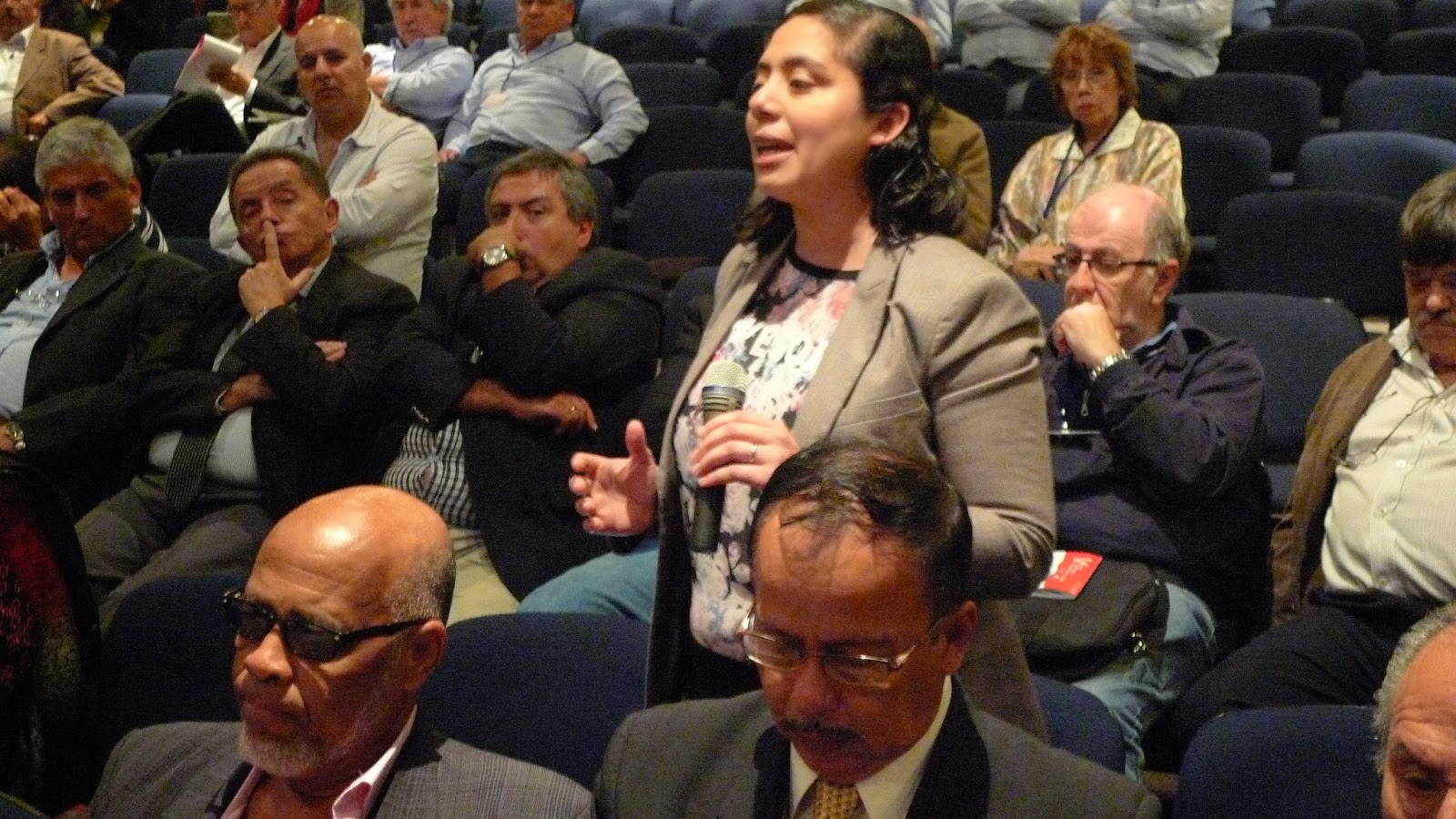
After each panel there was an opportunity for the participants to ask questions and to make observations for debate. Here we see Zuliana Laina from the Peruvian ANP ask some questions to the members of the panel.


Before the opening of the Fifth Coordination Meeting CLAC - WOW the participants had to register themselves officially.

Minister of Labour Francisco Javier Diaz opens officially the Coordination Meeting CLAC WOW.
The participants were invited by the minister for an evening dinner.


The next day, Tuesday November 25th, the meetings took place in Parque La Auraca, a recreational centre for employees of different enterprises. The morning consisted of 4 panales:
1. "The World of Work against Neoliberalism."
2. "Trade Unionism in the XXI century and social crisis."
3. "Autonomous Workers and Trade Union Self Reform."
4. "Women, Youth and new Trade Union Action."
After these panels, 4 Working Shops on the above mentioned items were formed. After the Working Shops had finished their debates, conclusions were made up and presented to all participants. The conclusions will be elaborated as soon as possible and be send to all participants.
Alle participants received a diploma as a proof of participation. The meeting ended with a party.

It was a well organized event for which we thank the companeros of FELATRACCS and especially our Chilean friends of FETRACOSE. With their excellent job, they have set a high standard for the meetings to follow in the next years. The next meeting will be in the Dominican Republic next year.

Panel 3 on "Autonomous Workers and Trade Union Self Reform."


Panel 4 on "Women, Youth and New Trade Union Action."


Registering for the workshops.


A special working shop on "Pensioners and Trade Action" was formed. The pensioners want to become a member of CLAC-WOW.


At the end of a long working day all participants received a diploma as proof of participation.It was a well organized event for which we thank the companeros of FELATRACCS and especially our Chilean friends of FETRACOSE. They did an excellent job putting a high standard for the meetings to follow in the next years.

Wednesday, November 12, 2014

THE DOWNFALL OF THE WCL 42


IFTC Board meeting with USOC Board in Barcelona with the ail to prepare the IFTC World Congress,
February 1999.
Under the leadership of Secretary General Willy Thys, the WCL Secretariat was reorganized in such a way that the planned combination of two functions was no longer possible, the function of European Confederal Secretary and Executive Secretary of several international trade union federations. In the absence of adequate secretarial support, it was impossible to fulfill both tasks. For unknown reasons the European liaison office in Bucarest in the headquarters of Cartel Alfa was terminated. The only employee at that office was brought to Brussels, but not at the European secretariat. Despite many conversations, there was no solution. In the absence of strategic coordination and a concerted policy at European level the WCL was becoming weaker.

Despite the lack of support from the WCL Secretariat, the governing bodies of the international federations continued to work on European and World level. Because of a lack of resources, both in manpower and financially, they had to limit themselves to certain priorities. That was not always easy because each international federation had its own preferences, beliefs and networks. Moreover, the lack of a global vision, necessary for a long term policy, resulted many times in a kind of anecdotal relations and a policy based primarily on personal preferences usually for one or more persons (trade union friends), sometimes for an organization or even a country (for example ex colonies). Unfortunately, even within the WCL secretariat itself there was not developed such a long-term vision with an associated practical and workable policy based on the overall objectives set at the world congress.


FMTI-FLATI seminar in Mexico City. From left to right:
WFIW President Jaap Wienen, FLATI President and WFIW Vice President Carlos Gaitan
and José Merced Gonzalez, ex WCL Confederal Secretary and CLAT Board Member. October 1999.

The executive Secretariat must spend a lot of time on the regular executive board meetings of each international trade union federation and once a year a world board that was almost always combined with a world seminar. There were also regional seminars in Europe and in the continents, special events and of course every four or five years a world congress. The Secretariat had its hands full with just these statutory meetings which are essential for the maintenance of an international network.
International trade union movement is above all networking and exchange of experience in many areas: collective bargaining, labor conditions, trade union and human rights, the behavior of multinational corporations, the application of ILO conventions, developing a vision on (international) economics, labour market, society and politics. All these areas are very complex and require a long-term approach.

The trade union with its democratic structures and decision making, based on defined responsibilities regulated by the statutes, ensure that slowly arises a democratic culture worldwide between workers and employees. That is of paramount importance for the future, at least if one believes that the world order should be based on the principles of democracy. Experiences with the United Nations teach us how important are the development of a democratic attitude and culture for world peace and the prevention of violent conflicts.

WFIW Congress particpants in Doorn, Netherlands, March 2000.


Besides this each international trade union federation had its own internal dynamics such as rapid changes in the composition of the boards. For example, Doekle Terpstra resigned as chair of the WFIW in January 1999, just after one year of presidency. Terpstra was the successor of Anton Westerlaken as chairman of the Dutch trade union confederation CNV and therefore also as treasurer of the Executive Board of the WCL. The WFIW presidency was provisionally transferred until the next World Congress to Jaap Wienen, who had worked together with Doekle Terpstra in the CNV industrial trade union. Jaap Wienen had already some experience on international level as a board member of the FIOST, the international federation for transport and communications affiliated to the WCL.

To give an idea of the many different activities of the international federations below is given a summary of some important activities.
- In January 1999 a meeting took place of the WFIW with the Danish Trade Union Confederation DKF in Denmark.
- In the context of the preparation of its World Congress the IFTC executive board visited the Catalan USOC organization of the Spanish trade union confederation USO in February 1999. In June of the same year the IFTC World Congress was held in Barcelona.
- In early March 1999 a seminar was held for miners unions from Central and Eastern Europe in Budapest, organized by the Christian Miners Foundation and in cooperation with the WFIW.
- Mid-March, the European Council of WFCW gathered in Mulhouse, France.
- At the end of April 1999 the Pan African Federation of Workers in the Building and Wood sector was founded in the education and training institute Fopadesh of the African organization DOAWTU.
- In September of the same year, the WFIW held its World Board meeting in Madrid.
- In October 1999 in Mexico City, a seminar is held by FLATIC , the regional Latin American federation for industrial and construction workers. A delegation of the WFIW participated in the meetings.
- In March 2000, the WFIW held its World Congress in Doorn, Netherlands. Jaap Wienen is elected chairman. During the congress a text is drawn up for a code of conduct for multinationals. The code of conduct should include the five basic rights of workers: a ban on child labor, forced labor and discrimination, respect for freedom of trade unions and negotiating collective agreements. In addition, reference is made to decent work: the right to a fair wage, safe and healthy working conditions and collective insurances against sickness and disability.


The WFBWW (Building and Woodworkers) World Congress was held in Windhoek, Namibia.
From left to right: Secretary General Dick van de Kamp (CNV Netherlands),
President Jacky Jackers (ACV_CSC Belgium), Namibian Minister of Labour and Borad Member Aloyisius Yon. May 2000.

- In May 2000 the WFBWW held its world congress in Windhoek, Namibia. Main topics were the development of the WFFBWW in the world, the support of the continental federations such as the newly established Panafrican Federation of Building and Wood Workers, a world seminar every year, and according to the financial possibilities seminars in the continents.

It is clear that despite the limited financial and human resources, the international trade union federations functioned at an acceptable level. Each international federation had an international network of affiliated members. They tried as much as possible to support their members in the Third World countries. In addition, the federations functioned as a network of exchange of experiences and also as a school where leaders could experience democratic governance and decision making. As mentioned earlier, this is not only important for the development of international trade unions but also for the development of a democratic world order. 

Friday, November 7, 2014

ARE TRADE UNIONS OLD FASHIONED?


Strike picket at the gate of the Volkswagen plant in Brussels, November 2006. Volkswagen was planning to close the whole plant.
A few days ago I heard for the first time a TV interviewer ask president Marc Leemans of the Belgium trade union confederation ACV if the trade union was not what old-fashioned? Of course the President did not agree. The trade union represents the interests of the workers and he knows what this means. As he himself explained, he is from a workers family with seven children. His mother did not have an easy life. Those times must not come back, he said. The interests of workers are therefore in good hands with him. However, this was was not an answer to the question.

In the Netherlands, on the other hand, already some time the trade unions are accused of being old-fashioned. Not by everyone, of course, but still disturbingly often. In short, the criticism is that trade unions are against any change, that they are only interested to represent their members, mostly older workers with a permanent contract and that they have no interest in the problems of youth. Meanwhile, young people are unemployed or have a low paid job without a permanent contract, lower social benefits, have to work longer and probably will have a lower pension. A gap threatens to grow between the older workers and young people. The older generation thinks only of himself, that is the allegation. In stead of solidarity, there is a generational conflict growing.

Meeting of workers of Volkswagen in front of the plant in Brussels, november 2006
The trade unions do not agree with this. They see themselves as progressive, modern, solidary, useful and important for country and people. They still have the status of official national representatives of all workers in the nation. They are the social partners of employers and politics. Their social dialogue led to social peace and political stability, the basis on which the postwar welfare state was built. The welfare state as organized solidarity.

But there were changes, partly due to the success of the welfare state itself. As a result of the welfare state people live longer, this threatens to make pensions based on the pay-as-you-go system priceless. As a result of the on going globalization, traditional industries disappeared like mining, steel, shipbuilding, textile industry etc., precisely those industries on which the sociopolitical power and collectivist solidarity model of trade unionism was based. The demise of traditional smokestack industry was followed by new industries with a growing individualization. Higher and better educated workers, also the result of the welfare state, are less charmed of the collectivistic solidarity model. They want to have part time work, have personal responsibility, if possible they want to change jobs etc. In the meantime the labor market asks for more flexible working hours and contracts, outsourcing, self-employed (millions of self-employed enter the labor market ) followed by privatization, liberalization etc. Globalization brought much turmoil on the labor market.

One of the strikers at the Volkswagen plant in Brussels, november 2006
The trade unions are since then facing two big problems: loss of thousands of members and a rapidly changing labor market as a result of individualization, globalization, liberalization and privatization. You can then try to stop this but then chances are great that you are going to miss the economic link with the world market and before you know you are losing the revenues on which the welfare state is built. More distribution of wealth will probably ease the pain, but not more than that. Economies built only on distribution of wealth, at the end bring poverty. Cuba and North Korea are extreme examples of this phenomenon. Investments are needed, preferably in the private and public sectors. Investments that also create new jobs.

The public debate in the Netherlands in recent years resulted into reforms such as raising the retirement age (within a period of approximately 2 years the pension age will be raised until 67) , a tighter and shorter unemployment insurance more focused on piloting the unemployed into a new job than financial assistance, stricter supervision of social services, limited subsidies for job creation for the disabled and stricter monitoring of care. On top of this, Governments call for more responsibility for a job, own income, health care and so on.

Meeting of the strikers at the Volkswagen plant in Brussels, november 2006
Slowly but surely, the image of the worker in the Netherlands changes from victim into an individual that is responsable for its own life. The welfare state is still there to support the workers when things go wrong but not anymore to take care from the cradle to the grave. For many unions this is like swearing in church, but their traditional power base has been undermined.

No wonder the unions are busy with themselves, looking for an answer to the lost social and political influence. Mergers of trade unions from various sectors is the answer to the loss of members. For example already a few years, the Dutch trade union confederation FNV is reorganizing its structures to bring all unions together under one roof. This means more centralism to give more socio-political body to the social dialogue. But centralism is at odds with individualization. Workers want like consumers more customized services and less imposed collectivist schemes. The mergers are therefore only the beginning of a response to the crises.

Two workers at the trade union meeting of workers of Volkswagen, november 2006
To make matters worse the new century began with an economic disaster of a magnitude that has not been seen since the crisis in the twenties and thirties of the last century. The consequences are now widely reported, but the answer is not yet found. Economists are fighting among themselves about what to do but nobody really knows. Unions are trying to save from the burning socioeconomic house what can be saved with classical solutions for example more money from the Government for all kind of investments which means also making more debts.

The trade unions do not need to be ashamed that they have no ready answers and great difficulty with the reforms, but they may be more open to suggestions. It is not constructive if trade unions do not want to talk about proposals of employers to look for ways the millions of self-employed to integrate in the social security system. The trade unions should also start a dialogue about the possibility for retired workers to continue working after they have reached the age of pensioning. Trade unions that are putting their heels in the sand, give indeed the impression of being old-fashioned.

Man at the solidarity bus is writing a message that begins with "We are not alone"